NotebookLM for Agentic Research: Where It Fits in 2026
NotebookLM, now Gemini Notebook, can discover sources, run code, and create research outputs. See where it fits and where human verification still matters.
The practical question is not whether NotebookLM looks more capable in 2026 than it did before. It is whether it materially shortens the path from finding relevant sources to forming a structured judgment and producing a usable research artifact.
Here, agentic research means a multi-stage workflow that can help with source discovery, analysis, synthesis, artifact creation, and handoff. It does not mean that the system independently owns research design, source screening, citation management, or final verification.
Google renamed NotebookLM to Gemini Notebook on July 16, 2026. The same standalone product can now help discover web sources, run code, and create reusable outputs. It still does not replace systematic search, research judgment, citation control, or checking important claims against the original evidence.
Why this matters for research workflows
Research workflows usually fail in the middle rather than at the beginning. Many people can collect sources. Many can also draft once their thinking is clear enough. The harder problem is the stretch in between: reading across a large document set, organizing notes, comparing claims, and turning scattered evidence into structured synthesis.
That is why this topic matters. If NotebookLM lowers friction in the middle of the workflow, it deserves a place in a default research stack. If it mainly adds convenience without changing the quality or speed of synthesis, then it is easier to treat it as optional.
This is also why the question is different from a generic chatbot comparison. In a broader NotebookLM vs ChatGPT comparison, the main issue is often source grounding versus flexibility. Here the issue is narrower: can NotebookLM serve as a high-leverage synthesis layer inside a research loop that still includes search, judgment, verification, and writing?
July 2026 update: NotebookLM is now Gemini Notebook
Google renamed NotebookLM to Gemini Notebook on July 16, 2026. It remains the same standalone product, so this guide keeps the established NotebookLM name where it helps readers connect older searches and workflows with the current product.
The rename followed Google's June 8 research update. For accounts included in the rollout, Gemini Notebook runs on Gemini 3.5 and Antigravity, can use a secure cloud computer for code execution, can help discover web sources, and can generate downloadable artifacts such as documents, structured data, spreadsheets, presentations, charts, and images. Availability can still vary by account and rollout stage.
That does not make Gemini Notebook a complete research agent. It does make the product stronger across discovery, analysis, and handoff. A source-grounded table, Markdown brief, spreadsheet, or slide outline is easier to audit and reuse than a chat answer. These are generated artifacts, not a raw export of the entire notebook, chat history, or citation graph. For the exact distinction, read the NotebookLM output formats and export limits guide.
There is also a quieter automation update worth separating from artifact creation. Google Workspace Updates says eligible Workspace users can use an existing notebook inside Workspace Studio flows through an Ask NotebookLM step. That can support recurring briefs, status summaries, and team workflows, but the result remains bounded by notebook sources, account availability, and the surrounding flow design.
If you want the cleaner Google-side comparison first, read Notebooks in Gemini vs. NotebookLM for Research and Study Workflows. That piece is useful if your choice is really about assistant-centered workspace versus source-centered notebook behavior.
What actually matters here
The most useful way to evaluate Gemini Notebook is not by asking whether its feature list sounds agentic. It is by asking whether the tool changes the workflow outcome in a meaningful and auditable way.
Three questions matter most:
- Does built-in web discovery help form a useful source set without being mistaken for exhaustive scholarly search?
- Does it make source-grounded synthesis and comparison of claims faster without collapsing evidence boundaries?
- Does it produce reusable artifacts while preserving a clear human verification step?
On those terms, Gemini Notebook can now enter the workflow earlier, but it remains strongest once a relevant source set is stable enough for comparison and synthesis.
High leverage for source-grounded analysis
- Source-grounded synthesis: NotebookLM works best once the material set already exists and the next job is structured reading and synthesis.
- Comparison of claims: It becomes more useful when the workflow depends on asking where sources agree, diverge, or leave gaps.
- Reading and note consolidation: It can reduce the friction of turning a large reading stack into a more usable map of evidence.
Useful with explicit workflow boundaries
- Not a complete discovery stack: Built-in web discovery helps with orientation, but systematic or field-complete searches still need scholarly databases and a documented search method.
- Not a writing endpoint: It lowers synthesis friction, but another tool or human pass is often still needed for framing and draft language.
- Not a substitute for judgment: It can organize evidence well, but it does not remove the need for evaluation, prioritization, or verification.
Workflow fit analysis
The clearest evaluation is stage by stage.
Source collection
Gemini Notebook can now start from a loose question, use Google Search or Deep Research to find web sources, and let the user decide which results enter the notebook. That moves the product earlier in the research loop than previous versions.
The boundary is completeness. Web discovery is useful for orientation, adjacent sources, and exploratory work. It is not a substitute for a reproducible Google Scholar, PubMed, Scopus, Web of Science, or library-database search when missing a paper could change the conclusion. The researcher still owns query design, inclusion criteria, deduplication, and screening.
Reading and note consolidation
This is where NotebookLM has the strongest case. The tool is well aligned with reading-heavy work where the challenge is not generating more ideas but getting through a large source set without losing structure.
That is why it often feels more valuable in practice than in a feature list. The workflow gain is not dramatic automation. It is the reduction of synthesis friction: faster note consolidation, cleaner source-based questioning, and less context switching between documents and summary notes.
Synthesis
NotebookLM is strongest when synthesis still needs to remain visibly tied to the source base. In that sense, it behaves more like a synthesis layer than a research agent. It helps produce structured interpretation from existing evidence, but it does not replace the act of deciding what the evidence means.
This distinction is important. If the question is "Can it summarize and organize a complex document set more efficiently?" the answer is often yes. If the question is "Can it take over the full burden of synthesis judgment?" the answer is much less convincing.
Comparison of claims
This is another area where NotebookLM can be high leverage. A meaningful part of research work is not just summarizing individual sources but comparing how sources align, diverge, or qualify one another. NotebookLM is better suited to this than a general chat tool when the work depends on staying inside a defined source set.
That does not mean the output should be trusted as final analysis. It does mean the tool can make the comparison stage faster and more structured, especially when the alternative is manual hopping between notes, PDFs, and partial summaries.
First-draft generation
NotebookLM can help the workflow move toward a first draft, but it is not obviously the final writing layer. In many real projects, its value is that it shortens the path to draft readiness rather than replacing the drafting step itself.
For that reason, it often works best with a second layer. A common pattern is NotebookLM for reading and synthesis first, then a more flexible assistant or direct human writing pass for outline shaping and prose. That is also why the question is not whether NotebookLM can do everything. It is whether it covers the most expensive middle segment of the loop well enough to justify staying in the stack.
Strong fit versus conditional fit
Not every research stage carries equal leverage, and a broader feature list does not automatically make a tool the right default.
Gemini Notebook is a strong fit when it meaningfully reduces the work between source selection, cross-source analysis, and an auditable output. It is a conditional fit when the difficult part of the project is exhaustive retrieval, formal screening, citation management, or final prose.
The strongest fit appears when:
- the workflow is document-first rather than discovery-first
- the source set is large enough that manual comparison becomes slow
- the main bottleneck is turning reading into structured synthesis
The fit becomes conditional when:
- source discovery must be exhaustive and reproducible
- the project is more exploratory than evidence-bounded
- the writing layer matters more than the reading layer
That is why Gemini Notebook is not always the highest-leverage tool in every research stack. It is easiest to justify when the project is reading-heavy, source-based, and explicit about the point where human verification begins.
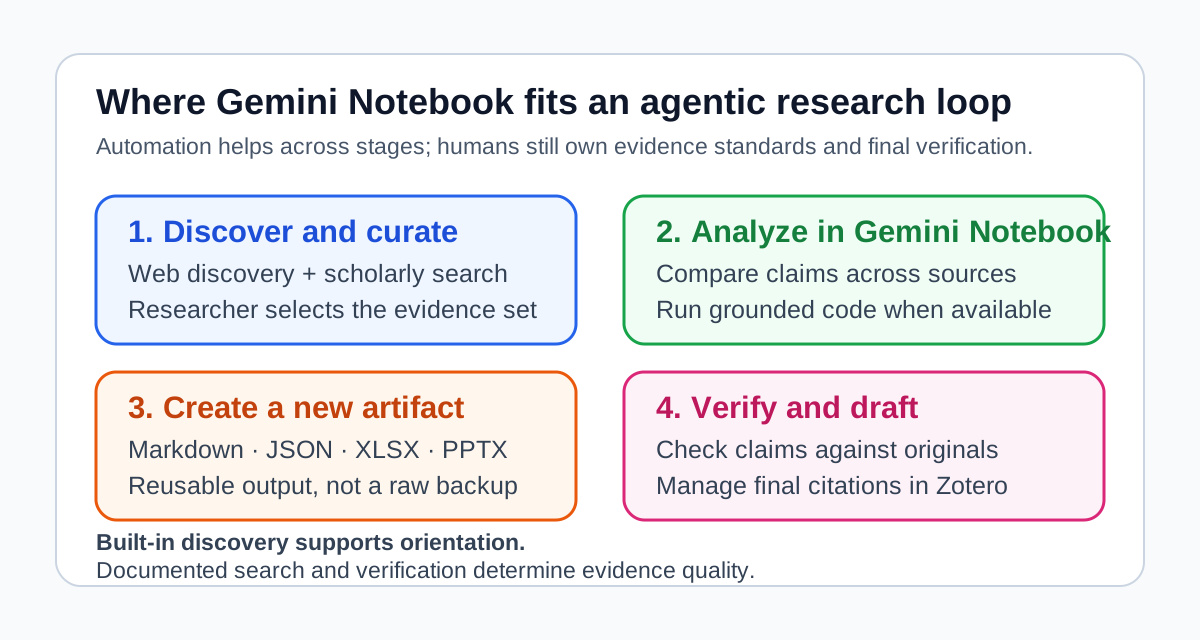
Agentic research loop
The practical loop is not "ask one agent and wait." It is closer to a recurring sequence:
Where Gemini Notebook fits the loop
The product can now help earlier with discovery, but its clearest advantage remains source-grounded analysis and artifact creation.
1. Collect
- Use built-in web discovery for orientation and supplementary sources.
- Use scholarly databases and a documented method when retrieval must be complete.
- Select a source set that is coherent enough to support comparison.
2. Understand
- Read across the source set instead of reviewing files one by one.
- Turn the material into structured notes and recurring themes.
- This is where NotebookLM becomes more useful once the source base is stable.
3. Synthesize
- Compare claims, surface disagreements, and organize evidence boundaries.
- Use the output to reduce the distance between reading and first-pass judgment.
- NotebookLM fits strongly here as a source-grounded synthesis layer.
4. Verify and write
- Check conclusions back against the source set and draft with human judgment.
- Bring in a writing layer if the workflow now needs structure, framing, or cleaner prose.
- NotebookLM helps prepare this stage, but it does not fully replace it.
This is why the relationship between Gemini Notebook and agentic research is best described as bounded automation rather than full autonomy. It can strengthen discovery, analysis, and artifact creation without owning the research question, evidence standard, or final conclusion.
If your work is closer to literature review than open-ended search, this is where NotebookLM becomes easier to justify. For that reason, readers working on paper-heavy synthesis may also want How to Use NotebookLM for Literature Review.
Where NotebookLM still falls short
The main limitation is not whether Gemini Notebook can search or create outputs. It can. The limitation is whether the workflow needs completeness, reproducibility, and responsibility that the product cannot establish on its own.
For systematic reviews and other high-stakes evidence work, built-in source discovery should be treated as supplementary. Database coverage, search strings, inclusion rules, deduplication, and screening decisions still need a separate record.
It is also less convincing if what you want is a fully autonomous research agent. That framing creates the wrong expectation. NotebookLM can help organize and synthesize a source base, but it does not make judgment disappear, and it does not turn a research process into a self-running pipeline.
The final limitation is that synthesis support should not be confused with validated conclusions. NotebookLM can help compress the path from reading to structured interpretation, but the responsibility for ranking evidence, resolving ambiguity, and deciding what is publication-worthy still belongs to the researcher.
Final verdict
Gemini Notebook is not a fully autonomous research system, and it is not the right tool for every stage of agentic research.
But that is not the most useful standard. The more practical question is whether it deserves to remain in a default research stack. For reading-heavy, source-based work, the answer is often yes.
It is best suited to researchers and knowledge workers who need to move from a selected source set through comparison, analysis, and structured outputs. It can now help begin from a vague question, but it should not be asked to autonomously own the full path through exhaustive discovery, validation, citation control, and final writing.
The restrained conclusion is also the most useful one: Gemini Notebook does not complete the agentic research loop, but it can be a high-value layer when source-grounded synthesis and reusable research artifacts are the real bottleneck.
Sources checked
- Google Blog: NotebookLM is now Gemini Notebook
- Google Blog: Do better research with NotebookLM
- Gemini Notebook Help: Add or discover new sources for your notebook
- Google Workspace Updates: Use NotebookLM in your Google Workspace Studio flows