Elicit vs NotebookLM: Paper Discovery vs Source Synthesis
Compare Elicit for academic paper discovery with Gemini Notebook for source-grounded synthesis, including where their discovery workflows now overlap.
Elicit and NotebookLM, now called Gemini Notebook, solve different research problems. Elicit is purpose-built for academic literature discovery and structured study comparison. Gemini Notebook can now discover and import candidate web or Drive sources, but it remains strongest as a grounded reading and synthesis workspace for the source set you choose.
That is why the best recommendation for many serious researchers is not to choose between them. It is to use them in sequence. Elicit helps you find and compare relevant literature. NotebookLM helps you read, question, and synthesize the sources you decide to keep.
Quick answer
- Use Elicit when you need to find papers, compare findings across published literature, or answer a research question with evidence from papers you have not gathered yet.
- Use Gemini Notebook when you need to gather candidate sources or read, compare, and synthesize a curated source set into structured notes.
- Use both when your workflow starts with academic paper discovery and ends with source-grounded synthesis.
- If you can only pick one, choose Elicit when your bottleneck is finding the right papers and choose NotebookLM when your bottleneck is making sense of a source set you already have.
The practical question is not which tool is better in general. The practical question is whether you are still building the source list or already working inside it.
Request the AI research workflow checklist
A practical checklist for choosing when to use NotebookLM, ChatGPT, Elicit, Consensus, Perplexity, Google Scholar, and Zotero.
No hype. Just workflow-first research tool decisions.
Elicit vs NotebookLM by workflow stage
Elicit remains stronger for academic-corpus search and study comparison; Gemini Notebook is stronger for grounded work inside a curated source set.
Best starting point
A source set you already trust and want to work through
A research question with no paper set yet
Core strength
Reading, questioning, and synthesizing your own uploaded sources
Finding, screening, and comparing studies across the literature
Source handling
Works with your uploaded PDFs, docs, URLs, and other notebook sources
Searches across a large academic corpus and structures evidence from published papers
Citation quality
Grounded answers with inline citations to your uploaded sources
Useful for evidence discovery tied to papers in its academic corpus
Best workflow stage
Reading, source-grounded questioning, and synthesis
Discovery and early literature comparison
Main limitation
Can discover web or Drive sources, but lacks Elicit's academic corpus, study filters, and screening workflow
Not the best place for deep, ongoing work inside your own private source pack
Paper discovery
Elicit wins clearly at paper discovery.
That is not a narrow advantage. It is the entire reason to use Elicit. Elicit is built around the literature search problem: finding relevant papers, surfacing findings, methods, and results, and helping you compare studies before you have chosen the final reading set. According to Elicit's help documentation, it searches across over 138 million academic papers from sources including Semantic Scholar, PubMed, and OpenAlex. The important point is not the exact number. The important point is that Elicit starts from the literature itself.
Use Elicit when you need to:
- search for papers around a defined question
- expand from a small set of seed papers
- compare study findings before reading everything in full
- build a more systematic literature review workflow
This is why Elicit is a strong fit for early literature review work. It helps you move from "what has been published on this question?" to "which papers actually belong in my review?"
Gemini Notebook now narrows this gap through Fast Research and Deep Research, which can search the web or Drive and import selected sources into a notebook. That makes it useful for exploratory source gathering. It still does not provide the same academic-corpus search, study-type filters, screening, and extraction workflow as Elicit—or the documented database strategy required for a formal systematic review.
If your immediate problem is finding and comparing academic papers, Elicit remains the more purpose-built starting point. Use Gemini Notebook discovery to supplement scoping or gather supporting material, then review every imported source before synthesis.
If you are currently deciding among search and review tools more broadly, Best AI Literature Review Tools is the better roundup to read next. If the real question is how Elicit compares to Consensus rather than to NotebookLM, see Elicit vs Consensus: Which AI Research Search Tool Fits?.
Source-grounded reading
NotebookLM wins clearly at source-grounded reading.
Once the paper set exists, the workflow changes. The question is no longer "what should I read?" The question becomes "what do these sources say, where do they agree, and how do I turn them into usable notes?" That is where NotebookLM is stronger than Elicit.
NotebookLM works with your uploaded sources: PDFs, documents, websites, and other materials you choose to put into a notebook. Its biggest advantage is not generic summarization. Its biggest advantage is grounded interaction inside a source set you control. It can answer questions against that source set and provide inline citations back to the notebook materials.
Use NotebookLM when you need to:
- read across a selected group of papers
- ask grounded questions about your uploaded materials
- extract themes across sources
- compare contradictions or recurring findings
- prepare structured notes before drafting
Elicit can help you compare literature at the discovery stage, but it is not the best place for deep, ongoing work inside your own curated source pack. NotebookLM is better once the reading problem becomes "help me work through these exact sources."
That is why How to Use NotebookLM for Research remains one of the most important follow-up guides after this comparison.
Synthesis and comparison
Both tools matter here, but they matter in different ways.
Elicit helps with cross-literature comparison. It is useful when you are still deciding which studies matter, trying to compare results across the published field, or quickly structuring evidence around a research question.
NotebookLM helps with cross-source synthesis from your documents. It is useful when you already have the papers, reports, or notes you care about and need to turn them into themes, contradictions, and structured synthesis.
The most useful way to think about this is:
- use Elicit to compare the literature you are still evaluating
- use NotebookLM to synthesize the source set you have already chosen
This distinction matters because many researchers use the wrong tool at the wrong time. They treat Gemini Notebook's generated source discovery as a complete scholarly search, or they ask Elicit to do the kind of slow, source-grounded reading work that is better handled inside a notebook environment.
If your current decision is actually between NotebookLM and a general assistant rather than NotebookLM and Elicit, NotebookLM vs ChatGPT for Research covers that split more directly.
When to use both together
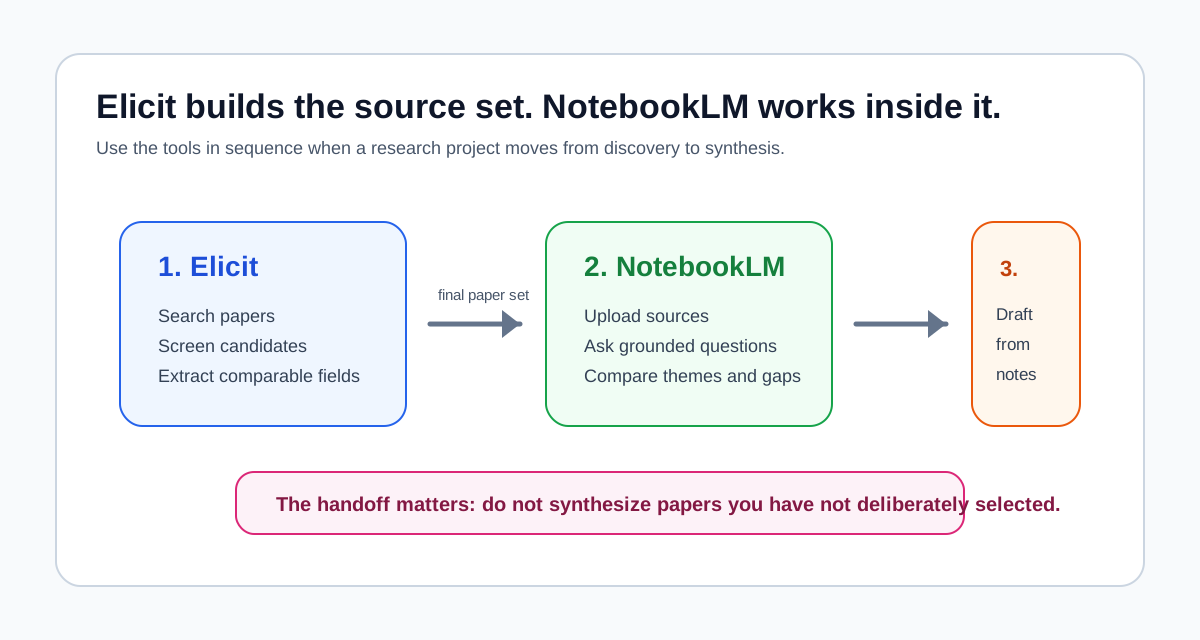
The strongest recommendation in this article is to use both in sequence.
Here is the cleanest workflow:
- Start in Elicit with your research question.
- Use Elicit to find relevant papers and compare early findings, methods, and results.
- Narrow the field to the papers that actually belong in your project.
- Export or collect those papers.
- Upload the final reading set into NotebookLM.
- Use NotebookLM to ask grounded questions, identify themes, compare contradictions, and prepare structured notes.
- Move into drafting only after that synthesis layer is clear.
This sequence is why these tools are complementary rather than competitive. Elicit helps you assemble the reading room. NotebookLM helps you work inside it.
That same logic shows up across the broader research-tool landscape. NotebookLM in 2026: Agentic Research, AI, and Synthesis Workflows is useful if you want the bigger picture of where NotebookLM fits after discovery is done.
When not to use Elicit
Do not use Elicit as your main workspace once you already have a stable, curated source pack and the hard part is deep reading across those materials.
Do not choose Elicit just because it looks more like a literature tool. If the real bottleneck is not finding papers but synthesizing the ones you already have, Elicit is no longer the main answer.
When not to use NotebookLM
Do not expect Gemini Notebook discovery to replace a formal literature search. It can find and import candidate sources, but a reproducible review still needs documented database queries, screening criteria, and coverage decisions. Elicit can support that workflow, while specialist databases and grey-literature sources may still be necessary for the field.
Best for whom
PhD students
PhD students should usually use Elicit first and NotebookLM second.
The usual bottleneck early in a project is paper discovery and scoping. That makes Elicit the better first tool. Once the reading list is real, NotebookLM becomes more valuable because the job shifts from finding sources to understanding them.
If you can only pick one:
- choose Elicit if you are still building the literature base
- choose NotebookLM if coursework, papers, or notes are already piled up and unread
Systematic reviewers
Systematic reviewers should usually start with Elicit because the workflow begins with structured search, screening, and evidence comparison. Elicit's own documentation also notes that grey literature, regional material, and specialized domains may require supplementary database searches.
NotebookLM can still be useful later, but it is not the primary tool for the early stages of a systematic workflow. It becomes more relevant after screening, when a selected set of materials needs deep reading and synthesis.
For this persona, Elicit usually matters more at the beginning.
Knowledge workers
Knowledge workers often need to decide whether their work starts from published literature or from internal documents.
If the work starts from published literature, Elicit is the better first stop.
If the work starts from internal PDFs, reports, transcripts, or a fixed source packet, NotebookLM is often the better first stop.
That is why knowledge workers should choose based on source type, not brand familiarity.
Final recommendation
Elicit and NotebookLM are not competing tools. They are complementary tools for different stages of a research workflow.
Use Elicit when your bottleneck is finding and comparing papers across the literature.
Use NotebookLM when your bottleneck is reading and synthesizing sources you already have.
Use both when the workflow starts with discovery and ends with source-grounded synthesis. That is the strongest recommendation in this article, and for many serious researchers it is the most effective setup.
If you can only choose one, the decision is simple:
- choose Elicit if you still need to find the right papers
- choose NotebookLM if you already have the papers and need to work through them
FAQ
If this comparison clarified the workflow split, these are the next two pages to read.
Related reading
- Best AI Literature Review Tools
- How to Use NotebookLM for Research
- NotebookLM vs ChatGPT for Research, Studying, and Literature Review
- NotebookLM in 2026: Agentic Research, AI, and Synthesis Workflows
- NotebookLM, Gemini Notebooks, ChatGPT Study Mode, and Perplexity for Research Workflows