Perplexity vs Elicit vs Consensus: AI Literature Search
Compare Perplexity, Elicit, and Consensus for literature search: Perplexity for scoping, Consensus for evidence checks, and Elicit for screening.
These tools are not interchangeable: pick by workflow stage, not by brand. Perplexity is best for scoping and orientation when the territory is unfamiliar. Consensus is best for a fast evidence pulse on a sharp question. Elicit is best when you need a defensible paper set, screening, and extraction tables.
If you are a grad student or researcher scoping a new literature, you do not need to choose one forever. You need to know which to reach for at each stage. Perplexity gets you oriented. Consensus checks whether your hypothesis has traction. Elicit does the structured review work.
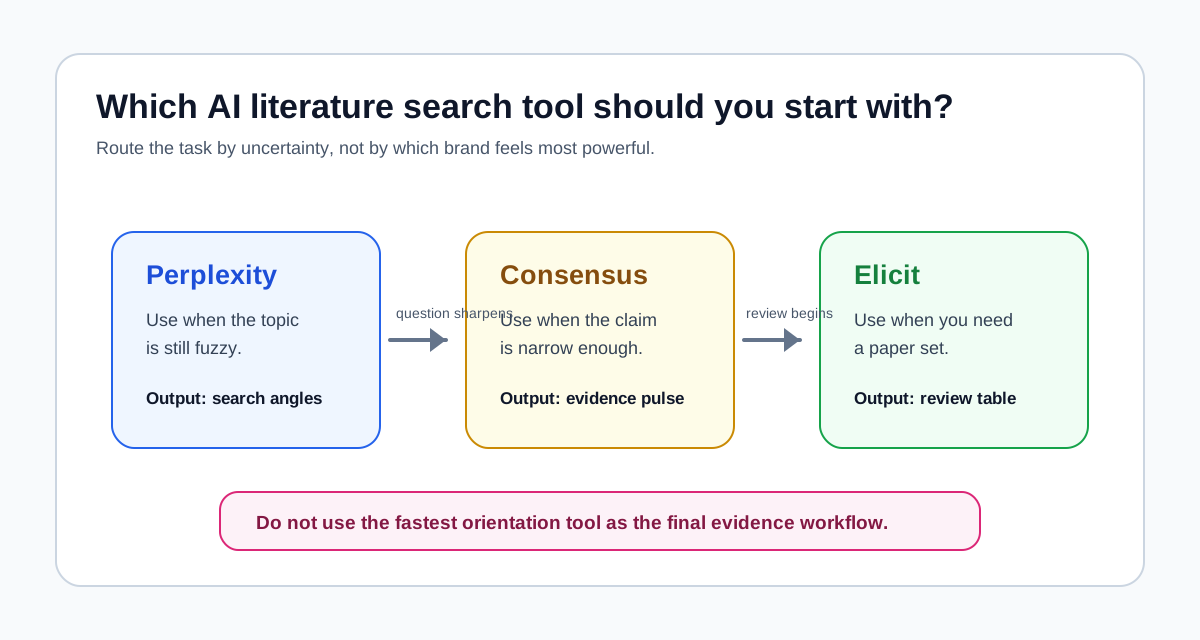
The short version: Perplexity maps the field, Consensus checks a claim, and Elicit builds the paper set. The mistake is using the fastest tool for the most defensible stage.
Check the next step for your research workflow
Pick the situation closest to yours. The recommendation updates inside the article, so you can keep reading with a clearer path.
Perplexity or Scholar -> Consensus check -> Elicit screening -> Zotero
Start with Perplexity for orientation, then Elicit or Google Scholar for paper search because your first job is to learn the vocabulary, candidate questions, and source trails before you trust any synthesis.
- 1Write one research question, collect 5-10 candidate search terms, then run a structured paper search before reading deeply.
- 2Use the first tool for orientation, then turn useful terms into a repeatable search.
- 3Name the bottleneck first: discovery, reading, synthesis, drafting, or citations. Choose tools by that stage.
Quick decision matrix
| Tool | Best for | Not for | Use with |
|---|---|---|---|
| Perplexity | Fast orientation, topic framing, cross-domain background, early drafting | Final evidence validation or a defensible paper set | Google Scholar or Elicit before you trust the evidence base |
| Elicit | Paper discovery, screening, extraction tables, review workflows | Vague early-stage exploration before the question is defined | Zotero for citation management; Consensus for quick claim checks |
| Consensus | Quick evidence checks on specific empirical questions | Building a full literature review table or drafting prose | Elicit when the question deserves a structured review |
If you are not sure which column describes your current problem, start with the AI Research Tool Selector. If you are designing the whole workflow rather than choosing among these three tools, use AI Research Workflow: Which Tool for Which Stage as the parent guide.
Literature review stage map
This comparison is easiest to use when each tool is assigned to a stage of the review rather than treated as a general "best AI research tool."
| Stage | Best first tool among these three | What to do next |
|---|---|---|
| Discovery and scoping | Perplexity | Convert the overview into search terms and sharper questions. |
| Evidence pulse | Consensus | Use the result to decide whether the question deserves deeper review. |
| Academic verification | Elicit | Screen papers, inspect metadata, and export the defensible set. |
| Source reading | Elicit for extracted fields, then another reading tool | Read the accepted papers closely before synthesis. |
| Synthesis and drafting | Perplexity, after verification | Draft from verified notes, not from the first broad answer. |
If you are choosing right now
Most readers do not arrive here with a clean workflow diagram. They arrive with a half-formed task: "I need papers," "I need to know if this claim is true," or "I need to turn this topic into a review section." Use this shorter routing rule before you open another tab.
| Your immediate task | Start here | Why |
|---|---|---|
| "I need to understand the topic before I search databases." | Perplexity | It is fastest for orientation, vocabulary, adjacent concepts, and possible search terms. |
| "I have one claim and need to know what the literature says." | Consensus | It is better for a quick evidence pulse on a specific empirical question. |
| "I need a paper list I can screen, extract, and defend." | Elicit | It is the closest fit when the output needs a structured review table. |
| "I already have papers and need to read across them." | A source-grounded reading workflow | Move from search into reading. The best AI literature review tools guide covers that next layer. |
If the question is still fuzzy, do not begin by building an extraction table. Use Perplexity to define the territory, turn that into candidate search terms, then move into Consensus or Elicit once the question has edges.
Tool quick reference
| Lens | Perplexity | Elicit | Consensus |
|---|---|---|---|
| Pricing | Free + paid plans | Free + paid plans | Free + paid plans |
| Free tier limits | Standard search; advanced research access varies by plan | Useful for exploration; exports and systematic review workflow require paid access | Basic paper search plus limited AI analysis volume |
| Source coverage | Web plus academic-focused search modes | Elicit paper index, PubMed option, OpenAlex and Semantic Scholar-derived paper data | OpenAlex, Semantic Scholar, PubMed corpus, and partner sources |
| Citation export | Copy/paste; no native RIS or BibTeX export | RIS, CSV, BibTeX export available | Limited export options |
| AI model | Perplexity search modes and selectable models on paid plans | Elicit research workflows and extraction models | Consensus search, Pro analysis, study snapshots, and deep review features |
| Key differentiator | Speed, breadth, conversational drafting, and increasingly agentic retrieval | Structured review workflow with extraction tables | Evidence-grounded Q&A with per-paper citations |
| Best workflow stage | Scoping, orientation, synthesis and drafting | Paper discovery, screening, structured extraction | Quick evidence validation, hypothesis checking |
| Hallucination risk | Higher — web-sourced, mixed academic and non-academic | Lower — constrained to academic paper corpus | Low for cited claims; verify AI-generated summaries |
Confirm current pricing, free-tier caps, corpus coverage, and export formats on each vendor site. Product lines change quickly; this table is a workflow map, not a price sheet.
A controlled comparison you can rerun
Do not compare these products with three different prompts. Give each tool the same research question and judge the artifact it produces, not how polished the answer sounds.
Use a question with a population, intervention, comparator, and outcome, for example:
In undergraduate students, does retrieval practice improve delayed retention compared with rereading?
Run the question once in each tool and keep this audit sheet beside you:
| Tool | Keep from the run | Verify before moving on | Failure signal |
|---|---|---|---|
| Perplexity | Search language, adjacent concepts, and citation leads | Open every paper you plan to carry forward and confirm it directly addresses the question | A fluent overview built from mixed web and academic sources is mistaken for the final evidence set |
| Consensus | Exact query, evidence direction, contributing papers, and any visible disagreement | Inspect the papers behind the meter or synthesis; Consensus says the meter reflects the most relevant returned papers, not all research on the topic | The top-line direction is copied without checking population, method, or outcome differences |
| Elicit | Search query, candidate paper table, screening decisions, extraction fields, and export | Deduplicate records, review exclusions, and spot-check extracted fields against supporting text | A large table is treated as defensible even though no inclusion logic or human checks were recorded |
The outputs should look different. Perplexity has succeeded if it sharpens the question. Consensus has succeeded if it gives a traceable evidence pulse. Elicit has succeeded if it leaves you with a paper-by-paper review artifact. If all three outputs are being used as interchangeable prose, the workflow has lost the distinction this comparison is meant to protect.
By workflow stage
Research does not move in a straight line, but it does move in recognizable phases. The tool that fits phase one is rarely the right tool for phase two.
Discovery and scoping: getting your bearings
When you are starting in unfamiliar territory, your job is to map the field: what are the main debates, which questions have been studied, and what language does the literature use. At this stage, you do not yet have a paper set — you may not even have a precise question.
Perplexity is the fastest tool for this stage. It handles vague or broad queries, synthesizes across web and academic sources, and produces a readable overview with cited links in under a minute. Ask "what are the main theories of cognitive load in educational settings?" and you get a usable conceptual map. That map is not a literature review, but it tells you where to look next. The Perplexity for Researchers: A Practical 2026 Guide covers this orientation workflow in more depth, including where Perplexity's breadth becomes a liability.
Perplexity's June 2026 Search as Code research note reinforces this role rather than changing the decision matrix. Programmable, agentic retrieval is promising for complex scoping questions because it can orchestrate many retrieval steps behind one task. It still does not provide the controlled academic corpus, screening table, or reproducible search record that a formal literature review needs.
Consensus becomes useful once your question sharpens. If you can state a specific empirical claim — "does retrieval practice improve long-term retention more than re-reading?" — Consensus searches its academic corpus and returns cited studies alongside an evidence verdict: agree, disagree, or mixed. That is more actionable than Perplexity's broad sweep when you have a precise hypothesis to check, and it gives you a reliable first sense of whether the literature supports your intuition.
Elicit is the wrong starting tool. It is built for a methodical workflow: define a search, screen results, extract information into structured columns. If you start in Elicit before you know what you are searching for, you will spend time managing results rather than understanding the landscape. Elicit rewards clarity. Use it after you have it.
Verdict for discovery and scoping: Start with Perplexity for unfamiliar territory. Move to Consensus once your question is specific. Save Elicit for the structured phase that follows.
Example: You are beginning a chapter on misinformation in vaccine decision-making. Perplexity gives you a readable map of the field — psychological theories, communication research, public health data. Consensus then answers: "Does correcting health misinformation reduce vaccine hesitancy?" — showing directly cited studies with a split verdict. Elicit takes over when you are ready to build a structured paper set around that specific question.
The transition point matters. If your Perplexity output gives you concepts, search terms, and a few possible angles, it has done its job. Do not ask it to become your final literature review. Move into Consensus when you need a fast check on one claim, and into Elicit when you are ready to collect papers systematically.
Validation and depth reading: verifying claims, building the source list
Once you have a research question, this stage is about finding the right papers, filtering for quality, extracting key information, and building a source list you can defend. This is where most of the actual work in an AI-assisted literature review happens.
Elicit wins this stage decisively. It lets you run a structured search and then systematically extract information from papers into columns: study type, sample size, methodology, key finding, limitations. You can screen titles and abstracts at speed, add papers to your review table, and export them as RIS or CSV. If you are writing a systematic or scoping review, Elicit is the closest AI-native tool to what a formal review process requires. For a direct comparison between Elicit and a document-synthesis tool at this stage, see Elicit vs NotebookLM: Paper Discovery vs Source Synthesis.
Consensus is useful for claim checking, but not as a review scaffold. It gives you a fast, paper-cited verdict on specific empirical questions. That is valuable for spot-checking — "has intermittent fasting been shown to improve insulin sensitivity in adults with prediabetes?" — but it does not give you a working paper list you can filter, screen, or export. Consensus answers questions. It does not build reviews.
Perplexity is the wrong tool for validation. It sources from a mix of web pages, preprints, and academic papers without clearly distinguishing between them. It does not support structured extraction, and its citations — while often real — are difficult to verify systematically. Using Perplexity to validate claims in a formal literature review is like using a general search engine instead of a database. It is faster to start and harder to defend in the end.
Verdict for validation: Default to Elicit. Use Consensus alongside it for specific empirical checks. Keep Perplexity out of the validation stage unless you are triangulating quickly with sources you can verify separately. The full comparison of Consensus vs Elicit: AI-Powered Research Search Compared is the most useful companion piece if you need to decide between just those two.
Example: You are doing a scoping review on AI-assisted radiology diagnostics. Elicit lets you search, surface 40 relevant studies, and extract columns for "study type," "accuracy metric reported," "imaging modality," and "comparison condition." That extraction table carries through to your methods and results. Consensus would tell you whether AI improves diagnostic accuracy in radiology — a useful first check, but not a usable scaffold.
Synthesis and drafting: turning sources into structure
Once you have your papers, the challenge shifts: turning evidence into arguments, framing your contribution, and producing readable prose that does not just summarize sources in sequence.
Perplexity has the clearest advantage among these three. It handles open-ended generative tasks — draft a paragraph arguing X given these findings, reframe this evidence as a research gap, suggest a structure for a literature review on Y — that Elicit and Consensus are not designed for. The conversational interface lets you iterate quickly. Perplexity Spaces, covered in Perplexity Spaces for Research Workflows, adds lightweight project organization that can help when you are moving between drafting and editing across a longer review.
Elicit is building toward synthesis features, but its core product remains search and extraction. You can ask questions about papers in your review table, but producing a structured literature review section from Elicit still requires you to do most of the prose work manually. That is fine — it is not what Elicit is for.
Consensus is not a drafting tool. It answers questions; it does not write paragraphs. Do not try to use it for synthesis work.
Verdict for synthesis and drafting: Perplexity. If you are weighing Perplexity against a generalist alternative for research drafting, Perplexity vs ChatGPT: Research Workflow Compared walks through the tradeoffs in detail. If your source set is large and you need deep synthesis tied closely to specific documents, a dedicated document-synthesis tool like NotebookLM handles that better — but that is outside this comparison.
Example: You have 18 papers on peer feedback in online learning and you need to draft the "Research Gaps" section of your literature review. Perplexity can take a summary of what your sources collectively found and generate a framed paragraph noting where the literature has focused and where it has not. Elicit would help you check whether you missed a major study. Consensus would let you verify whether a specific claim about peer feedback is supported.
For a source-grounded reading and synthesis stack beyond these three, see Best AI Literature Review Tools. That page covers the handoff from discovery and screening into source reading, synthesis, and drafting.
Pricing and access
Prices below reflect publicly available information as of May 2026. Fact-check pricing and free-tier limits on each vendor site before citing.
Perplexity: The free tier is enough for lightweight orientation. Paid plans matter when you need more advanced search modes, file analysis, model switching, or deeper research reports. For a full breakdown of what the paid tier actually adds for researchers, see Perplexity Free vs Pro for Students and Researchers.
Elicit: The free tier is useful for exploration and early paper search. Paid access becomes important when you need exports, more table work, or the dedicated systematic review workflow. For researchers running genuine systematic or scoping reviews, Elicit is more defensible as a workflow tool than a general AI answer engine.
Consensus: The free tier is workable for basic paper search and occasional evidence checks. Paid plans become relevant when you need more AI analysis, deep reviews, study snapshots, and saved research workflows. The free tier is a reasonable starting point for a researcher who wants to test whether Consensus fits their question style.
When each tool wins
Use Perplexity when
You are starting in unfamiliar territory and need a fast, readable overview before committing to databases. Perplexity is also the right tool when you need to draft, synthesize, or iterate on prose — and when your research crosses domains that academic paper search tools index unevenly. The comparison in Perplexity vs Google Scholar: Is AI Search Good Enough for Research? frames the clearest boundary between Perplexity's speed and academic search's rigor.
Use Elicit when
You have a specific question and need to find, screen, and extract from a structured set of academic papers. Elicit is the only tool in this comparison that is built to support a formal literature review process — with searchable academic databases, structured extraction tables, screening workflows, and export to reference managers. If your final deliverable is a systematic review, a scoping review, or any document where your methodology section needs to describe how you found and selected papers, Elicit is the tool that can actually be named there.
Use Consensus when
You need a quick, research-grounded answer to a specific empirical question as a first pass — before you spend hours in Elicit running a full search. Consensus is also useful mid-review for verifying a specific claim without breaking your extraction workflow. It is fast, cites its sources, and gives you a useful signal on whether the literature broadly supports or contests a claim.
Perplexity vs Elicit vs Consensus: frequently asked questions
Short answers to the comparison questions that show up most often in search and office hours.
Conclusion
Perplexity, Elicit, and Consensus cover different positions in a literature search and review workflow. Perplexity is fastest for orientation and drafting. Consensus is most efficient for evidence-checking a specific question. Elicit is the only one of the three built for the structured work that a real literature review requires. The most common mistake is treating them as alternatives to each other — picking one and using it for everything — rather than assigning each one its stage.
If you are building a research workflow rather than a one-off review, the practical rule is: use Consensus to check if the question is worth pursuing, use Elicit to build the review, and reach for Perplexity when you need speed or prose.
Sources checked
- Perplexity Pro help center
- Perplexity Pro Search help center
- Perplexity Research: Rethinking Search as Code Generation
- Elicit pricing
- Elicit export documentation
- Elicit paper sources
- Consensus research database
- Consensus subscription plans
Related reading
- Perplexity for Researchers: A Practical 2026 Guide
- Consensus vs Elicit: AI-Powered Research Search Compared
- Perplexity vs Google Scholar: When to Use Each for Research
- Best AI Literature Review Tools
- AI Research Tool Selector
- AI Research Workflow: Which Tool for Which Stage
- Elicit vs NotebookLM: Paper Discovery vs Source Synthesis
- Perplexity vs ChatGPT: Research Workflow Compared