Consensus vs Elicit: Which AI Research Search Tool Should You Use?
Compare Consensus and Elicit for AI research search: quick evidence checks vs structured paper discovery, screening, and literature review extraction.
Use Consensus when you need a fast evidence check on a specific research question. Use Elicit when you need paper discovery, screening, extraction, and a structured literature review workflow. If you are comparing research assistant features, Elicit is the stronger workflow tool; Consensus is the faster evidence-checking layer.
| Tool | Best for | Not for | Use with |
|---|---|---|---|
| Consensus | Fast evidence checks on specific research questions | Building a full review workflow | Elicit for screening and extraction |
| Elicit | Paper discovery, screening, extraction, and structured review work | Quick yes/no orientation only | Consensus for a first evidence pulse |
In practice, I reach for Consensus when I need to know whether a claim has research support before investing more time. I reach for Elicit when the project becomes a review process: finding papers, narrowing the set, and extracting comparable information. The first tool reduces uncertainty; the second turns uncertainty into a working paper set.
For a literature review, Consensus belongs before or beside the review, not at the center of it. Use it for evidence-pulse questions such as "does this intervention work?" Use Elicit when you need to turn that question into paper discovery, screening, and extraction. If you want a broader routing view before choosing, use the AI Research Tool Selector or the AI research workflow guide.
Check the next step for your research workflow
Pick the situation closest to yours. The recommendation updates inside the article, so you can keep reading with a clearer path.
Perplexity or Scholar -> Consensus check -> Elicit screening -> Zotero
Start with Elicit because screening needs a paper set, explicit inclusion logic, and comparable fields rather than a conversational answer.
- 1Write one research question, collect 5-10 candidate search terms, then run a structured paper search before reading deeply.
- 2Define inclusion and exclusion criteria before accepting any AI-assisted screening suggestion.
- 3Name the bottleneck first: discovery, reading, synthesis, drafting, or citations. Choose tools by that stage.
Quick answer
- Use Consensus when you want a fast answer grounded in published research and need to orient yourself quickly.
- Use Elicit when you need paper discovery, screening, structured extraction, and a more formal evidence workflow.
- Use both when you want Consensus to frame the topic first and Elicit to build the actual review set.
- Do not use Consensus as your full literature review workspace.
- Do not use Elicit if your only need is a quick evidence pulse on a question.
If the question is "which AI research assistant should I trust for a literature review workflow?", the answer depends on whether you need orientation or a reusable paper-review process. Consensus is the faster first stop. Elicit is the stronger system once the work starts to resemble a real literature review.
| Literature review stage | Better fit | Practical reason |
|---|---|---|
| Discovery | Elicit | You need a paper set, not only an answer. |
| Evidence pulse | Consensus | You need to know whether a specific claim has support. |
| Academic verification | Elicit plus manual checking | You need to screen papers and inspect source details. |
| Source reading | Neither as the main tool | Move the final source set into a reading or synthesis workflow. |
| Synthesis | Elicit for extracted fields; another tool for prose | Do not confuse extraction with final argument-building. |
June 2026 evidence update: useful, but not autonomous
Two June 2026 signals sharpen the recommendation without overturning it.
First, a BMC Medical Research Methodology study evaluated Elicit's systematic reviews workflow against a traditional umbrella review workflow. The study found that Elicit can support review phases and reduce manual work, but it did not independently reproduce the rigor required for high-quality evidence synthesis. In the reported comparison, title-and-abstract screening reached 90.9% recall and 42.9% precision, full-text screening reached 100% recall and 62.5% precision, and quality appraisal showed 24.4% disagreement on general AMSTAR-2 EH items and 30.4% disagreement on additional items.
That is a useful result, not a failure. It supports the practical recommendation in this article: use Elicit as a structured assistant inside a human-supervised review workflow, not as a one-click systematic review machine.
Second, Consensus has continued moving beyond quick answers with Citation Graph, Paper Search, My Library improvements, full-text access from major publishers when available, and integrations with ChatGPT, Claude, and API workflows. Those updates make Consensus more useful than a simple search box, but its strongest default role is still early evidence orientation and claim checking.
| June 2026 signal | What it means | How to use it |
|---|---|---|
| BMC study on Elicit | Elicit can help with screening and extraction, but still needs human oversight | Use Elicit for structured review workflow, then verify |
| Consensus changelog | Consensus is becoming a broader evidence workspace | Use it for fast orientation, citation graph exploration, and saved library work |
| SciSpace benchmark | SciSpace Deep Review performed strongly in a vendor-run benchmark | Treat it as a tool worth testing, not as independent proof of a new winner |
The SciSpace point is worth a caveat. SciSpace published a benchmark across 200 complex queries where its Deep Review mode led on precision at most measured depths and returned more highly relevant papers on average than Elicit or Consensus. But the benchmark was run by the SciSpace research team, with AI-model judging rather than a fully independent human gold standard. It is useful directional evidence and a reason to test SciSpace in broader comparisons, not a reason to replace workflow-based tool selection with one benchmark.
Consensus vs Elicit at a glance
These tools overlap in research search, but not in workflow depth.
Best starting point
Structured literature search
Quick evidence orientation
Core strength
Finding, screening, and comparing papers
Seeing what the research broadly says
Source handling
Best for paper lists, extraction, and review workflows
Best for fast answers from the research database
Citation quality
Better for formal review and paper-by-paper tracking
Good for fast evidence grounding
Best workflow stage
Discovery and screening
Early orientation
Main limitation
More process-heavy than many casual users need
Not a full review system
Quick evidence orientation
Consensus wins when the reader needs a fast, research-grounded answer to a question and is not yet ready to run a full literature review workflow.
This is especially useful when you are trying to determine whether a topic is worth deeper investigation. Consensus helps you move from vague curiosity to evidence-backed orientation quickly. It is not just about finding papers. It is about getting a disciplined first read on the literature without manually scanning everything.
Use Consensus when you need to:
- get a fast sense of whether published evidence trends in one direction
- clarify whether a claim has substantial research behind it
- orient yourself before investing in deeper review
- bring an evidence layer into knowledge work or early academic framing
That is why Consensus is often more useful than a general chatbot at the very start of a research question. It begins with the literature rather than with fluent prose. For many users, that already improves the quality of early-stage search.
The limitation is equally clear: once the task becomes systematic, Consensus is no longer the strongest workspace. It helps you orient. It does not replace the more structured steps of screening and synthesis.
Structured literature search
Elicit wins once the work begins to look like literature review rather than quick orientation.
This is where the comparison becomes clearer. Elicit is built around the idea that finding papers is not enough. You also need a way to compare them, extract useful fields, narrow them, and build a review set without losing control of what you are including or excluding.
Use Elicit when you need to:
- search for papers around a well-formed research question
- screen candidate studies
- compare studies in a structured way
- move from discovery into a literature review workflow
That is why Elicit is the better recommendation for researchers, graduate students, and anyone doing source-heavy review work. It is much closer to an actual research workflow than a quick-answer engine.
If your next step after discovery is source-grounded reading and synthesis, then this article fits naturally with Elicit vs NotebookLM: Paper Discovery vs Source Synthesis. Elicit helps you find and narrow the paper set. NotebookLM becomes stronger after that set already exists.
When to use both
The strongest workflow is not to choose one and ignore the other. It is to sequence them.
Here is the pattern that makes the most sense:
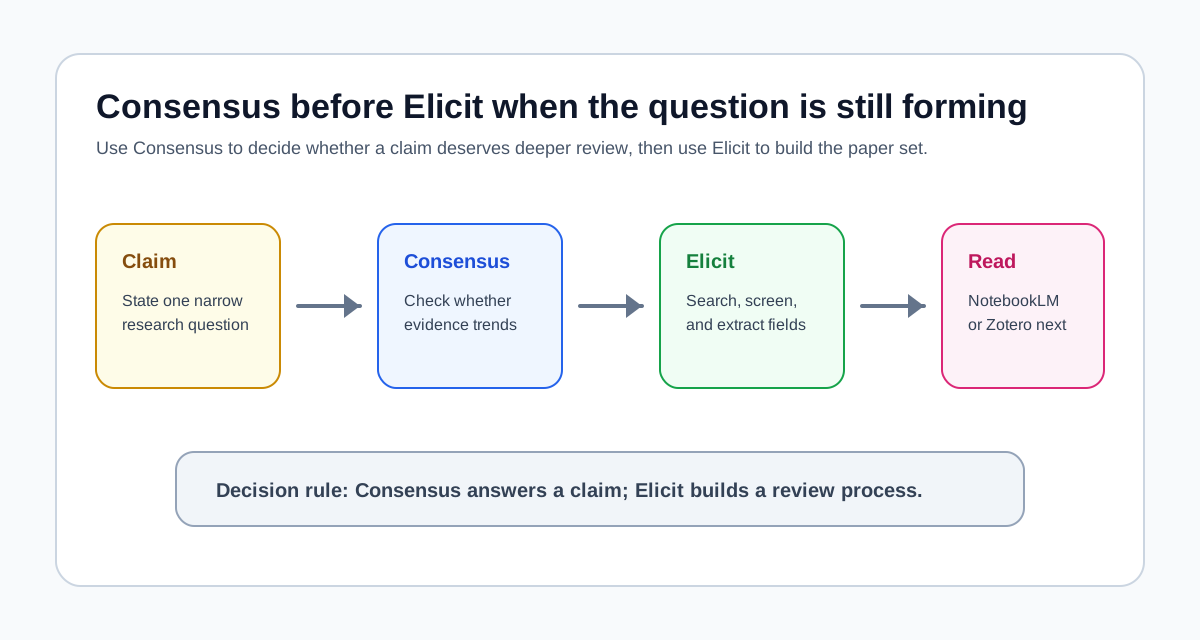
- Start in Consensus when the question is still broad and you need a quick evidence-oriented pulse.
- Move into Elicit when the topic is real enough to justify paper collection, screening, and structured comparison.
- Export or narrow the final paper set for reading and synthesis in another tool if needed.
This sequence is especially helpful for people who are time-constrained. Consensus helps you avoid overcommitting too early. Elicit helps you avoid staying shallow once the topic turns serious.
Step-by-step workflow: Consensus plus Elicit
Use this sequence when you are moving from a vague research topic toward a real literature review:
| Step | Tool | What to do | Output |
|---|---|---|---|
| 1. State the claim | Consensus | Ask one narrow question, not a broad topic prompt. | A first read on whether the literature broadly supports, rejects, or complicates the claim. |
| 2. Turn the claim into search terms | Consensus plus manual notes | Pull out repeated concepts, populations, interventions, or outcomes from the answer. | Search terms you can defend instead of a vague AI prompt. |
| 3. Build the paper set | Elicit | Search with those terms, then screen titles and abstracts. | A candidate set of papers, not only a synthesized answer. |
| 4. Extract comparable fields | Elicit | Add fields such as method, sample, outcome, limitation, and key finding. | A review table you can inspect and revise. |
| 5. Move to reading and citations | NotebookLM or Zotero | Read the accepted papers closely and store citation metadata separately. | Source-grounded notes and a library you can cite from. |
The important move is not "Consensus or Elicit." It is Consensus before Elicit when you need a quick evidence pulse, and Elicit after Consensus when the work deserves a paper-by-paper review.
If you are deciding across the full workflow rather than only search, AI Research Workflow in 2026: Which Tool for Which Stage is the better parent guide.
Run a one-question audit
Use the same narrow question in both tools, then compare what you can still inspect thirty minutes later. For example:
Does retrieval practice improve delayed retention in undergraduate students compared with rereading?
| Audit item | Consensus record | Elicit record |
|---|---|---|
| Exact question | Save the query and search mode | Save the review question and search query |
| Evidence unit | Papers behind the answer or Consensus Meter | Candidate papers and screening rows |
| Decision trail | Why the result appears supportive, negative, possible, or mixed | Why each paper was included or excluded |
| Structured comparison | Inspect study details and cited papers | Define extraction columns such as population, intervention, comparator, outcome, and limitation |
| What survives into writing | A traceable early evidence pulse | A reusable paper set and extraction table |
| Required human check | Open the contributing papers and inspect nuance | Check screening decisions and supporting text for extracted fields |
This audit exposes the actual product difference. Consensus is useful when the saved artifact is a question and the papers that shaped its answer. Elicit is useful when the saved artifact must become a review table that another person can inspect. Neither artifact should bypass reading the accepted papers.
Overlap with ChatGPT and Perplexity
Consensus and Elicit both overlap slightly with broader AI research tools, but neither should be confused with them.
ChatGPT can help frame a question, generate search terms, or rephrase a topic. Perplexity can help with broad web exploration. Neither is the cleanest choice when the job is specifically academic search with evidence discipline.
If Perplexity is also in your shortlist, use the broader Perplexity, Elicit, and Consensus workflow comparison instead of treating this as a two-tool decision.
That is why most serious users end up with a layered stack:
- a research-search tool like Consensus or Elicit
- a source-grounded reading tool later, such as NotebookLM
- a drafting assistant after the evidence work is done
If you are trying to choose that larger stack, Best AI Literature Review Tools and Best AI Tools for PhD Students and Researchers in 2026 are the most relevant follow-ups.
The practical sequence is simple: use Consensus to decide whether a question is worth deeper review, use Elicit to build the candidate paper set, then move the accepted sources into a source-reading workflow before drafting. That separation keeps a quick answer from becoming the whole review.
Best for whom
Students
Students should usually start with Consensus if they need a fast understanding of whether the literature supports a claim. It is easier to use and faster to benefit from. Elicit becomes worth the extra structure when the assignment is genuinely research-heavy and includes formal source collection or literature review work.
Researchers
Researchers should usually start with Elicit. The reason is simple: once rigor matters, process matters. Elicit gives more control over how papers are found, compared, and narrowed. Consensus can still be useful as an early orientation layer, but it is not usually enough on its own for serious review work.
Knowledge workers
Knowledge workers should usually start with Consensus unless their work closely resembles academic review. Analysts, policy staff, consultants, and strategy teams often need published evidence quickly, not a full literature workflow. Elicit is still valuable when the project crosses into deeper research or evidence synthesis, but it is not the best default for every question.
Final recommendation
Choose Consensus if your bottleneck is early-stage evidence orientation.
Choose Elicit if your bottleneck is structured academic discovery and literature review workflow.
Use both if the work matters enough to justify a sequence: Consensus first to understand the terrain, Elicit next to build and narrow the actual paper set. That is the strongest recommendation because it respects how research search really works. Early orientation and formal review are not the same task.
Consensus is the better casual starting point. Elicit is the better serious research tool. If you only have time for one decision, pick based on whether you need a quick evidence pulse or a real review process.
Open the AI Research Tool Selector
A simple decision matrix for choosing NotebookLM, Elicit, Consensus, Perplexity, ChatGPT, Google Scholar, and Zotero.
Open the AI Research Tool SelectorCommon questions
Related reading
- Best AI Literature Review Tools
- Perplexity vs Elicit vs Consensus for Academic Research
- AI Research Tool Selector
- Elicit vs NotebookLM: Paper Discovery vs Source Synthesis
- AI Research Workflow in 2026: Which Tool for Which Stage
- Best AI Tools for PhD Students and Researchers in 2026
Sources and official references
- Consensus
- Consensus Help Center
- Consensus search best practices
- Consensus Product Changelog
- Elicit
- Elicit Help Center
- Evaluating Elicit's systematic reviews workflow in an umbrella review on air pollution and acute lower respiratory infections
- SciSpace vs Elicit vs Consensus: AI Literature Search Benchmark