ChatGPT for Studying: What Actually Works and What Does Not
ChatGPT is great for explaining concepts and outlining essays. It is bad for finding sources and citing facts. Here is how to use it safely for studying.
ChatGPT is the most popular AI study tool in the world, but most students use it wrong. The biggest risk is not that it gives bad answers. The risk is that it gives confident-sounding answers that are subtly wrong and you cite them in your essay.
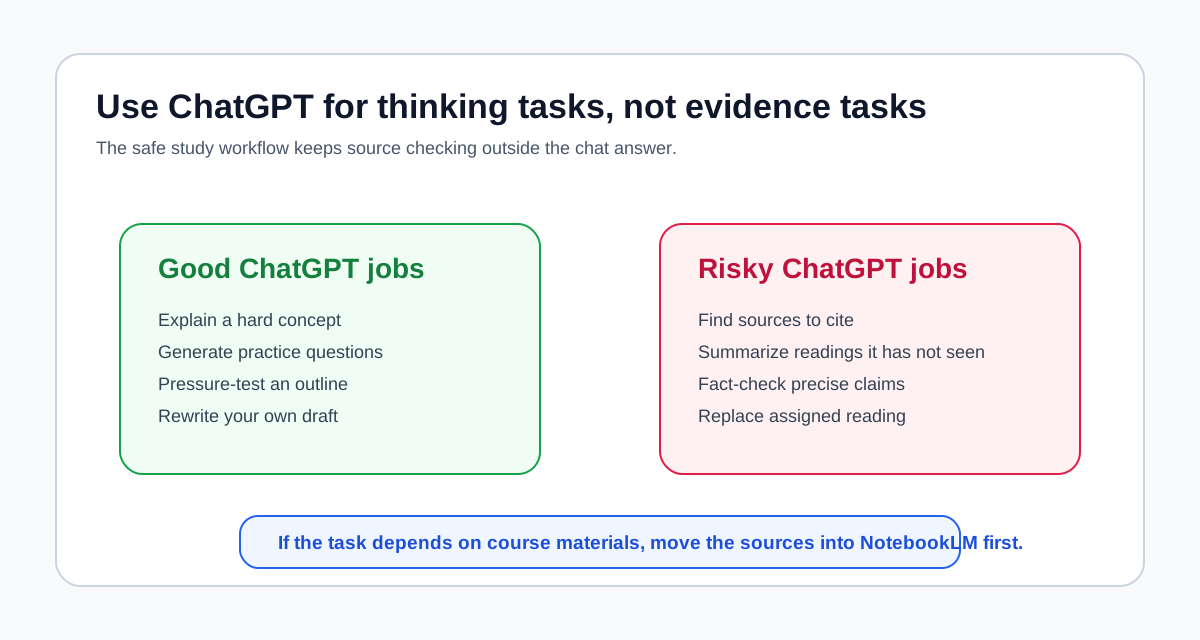
That is why the safest way to use ChatGPT for studying is narrow and practical. Use it for thinking tasks, explanation, and writing support. Do not use it as your evidence layer, your source finder, or your substitute for assigned reading.
Quick answer
- ChatGPT is good for explaining concepts, brainstorming essay angles, outlining, rewriting drafts, and practicing Q&A.
- ChatGPT is bad for finding sources, citing facts, and answering questions about specific readings you were assigned.
- The safest rule is simple: use ChatGPT for thinking tasks, not evidence tasks.
- If the assignment depends on your specific course materials, NotebookLM is usually the better tool.
- If you use ChatGPT for studying, verify anything factual before you trust it.
Where Study Mode fits
OpenAI's Study Mode announcement describes it as a learning experience that guides students step by step rather than jumping straight to an answer. The Study Mode FAQ says you can enable it from the slash menu by choosing "Study and learn" and get better results by sharing your level, topic, deadline, and helpful class context.
That makes Study Mode useful for homework walkthroughs, exam prep, and unpacking concepts from class. It does not change the core rule in this guide: ChatGPT can help you learn and rehearse, but sources and citations still need to be checked against course materials or reliable references.
What ChatGPT is actually good at for studying
ChatGPT is useful when the problem is not "what does this source say?" but "how can I think about this more clearly?"
That is where it earns its place in a student workflow. It is not reliable because it knows your assigned material. It is useful because it can help you process, explain, structure, and rehearse ideas.
Explaining hard concepts in plain language
This is one of ChatGPT's best study uses.
If you are stuck on a concept, theory, or technical term, ChatGPT can often explain it in a simpler way than your textbook or lecture did. That helps most when:
- the wording in class feels too abstract
- you need a simpler first pass before going back to the formal version
- you want an analogy or more basic explanation
The important limit is that the explanation may be smoother than it is precise. That is why ChatGPT is a good first explanation tool, not a final authority.
Generating practice questions
ChatGPT is also good at helping you practice active recall.
You can ask it to generate:
- quiz questions
- short-answer questions
- multiple-choice questions
- exam-style prompts
This works well because practice questions do not require perfect factual certainty in the same way citation work does. They require structure, difficulty, and repetition. ChatGPT is usually good enough at that to be useful.
Brainstorming essay angles
When you already know the assignment and have done at least some reading, ChatGPT can be helpful for generating possible thesis angles, counterarguments, and structures.
This is not the same as asking it to write your paper for you. The productive use is:
- test several possible claims
- ask for competing outline structures
- pressure-test whether an argument sounds too broad or too weak
That is where ChatGPT can save time without taking over the work.
Outlining papers and structuring arguments
Once you already have your own ideas and source notes, ChatGPT is often useful for structure.
It can help with:
- ordering sections
- finding missing transitions
- testing different outline patterns
- turning messy bullet points into a usable paper plan
This is one reason many students still benefit from ChatGPT even when a source-grounded tool is better earlier in the process. NotebookLM may help you understand the sources. ChatGPT may help you shape the draft.
Rewriting for clarity
This is one of the safest uses of ChatGPT if you already wrote the paragraph yourself.
Use it to:
- make a paragraph clearer
- shorten wordy sentences
- simplify clunky phrasing
- adjust tone to sound more academic or more direct
That is a much safer use than asking it to generate evidence or source claims from scratch.
Translating academic jargon
Some readings are difficult because the ideas are hard. Others are difficult because the writing is dense. ChatGPT can be good at turning jargon into simpler language, which helps you understand what you still need to read more closely.
What ChatGPT is bad at for studying
Students get into trouble with ChatGPT when they use it for the wrong kinds of tasks.
Finding real academic sources
This is one of the weakest and riskiest uses.
ChatGPT can sound persuasive when recommending papers, but it can also invent:
- paper titles
- author names
- journal details
- DOIs
That means it should not be your primary source-finding tool. If you need real academic sources, use Elicit, Semantic Scholar, or Google Scholar instead.
Answering questions about specific assigned readings
If you were assigned three articles, ChatGPT has not automatically read those articles. It can still say something fluent, but that does not mean the answer reflects your readings.
This is where NotebookLM is usually stronger. If the task is source-based and depends on your actual materials, NotebookLM vs ChatGPT for Studying, Research, and Literature Review is the comparison that matters most.
Fact-checking claims
ChatGPT prioritizes fluent response generation, not strict factual verification.
That means it is a weak fact-checking tool when:
- precision matters
- the assignment depends on exact definitions
- the claim needs citation support
- the reading includes subtle distinctions
In those cases, you still need to check the source material or use a more reliable source-search workflow.
Summarizing a paper you have not read
This is risky for the same reason. If you have not read the paper, you cannot judge whether the summary is accurate, incomplete, or slightly distorted.
That is why ChatGPT should not become a shortcut around the reading. It can help after you read. It is weaker when it tries to replace the reading.
The biggest danger: hallucinated citations
This is the number one reason students get in trouble with AI.
ChatGPT can confidently invent academic references that look real enough to pass a quick glance. A title may sound plausible. An author name may look familiar. A DOI may even look correctly formatted. None of that means the citation is real.
This creates a serious academic risk because students often assume that polished output means trustworthy output. It does not.
The practical rule is:
- use ChatGPT for ideas, structure, and explanation
- do not use ChatGPT as your source generator
If you need sources, use dedicated research tools instead. That is also why How to Use AI for Reading Research Papers Faster and Best AI Tools for PhD Students and Researchers recommend source-oriented tools for evidence work rather than ChatGPT.
ChatGPT vs NotebookLM for studying
The practical difference is clean:
- ChatGPT is better for general explanation, brainstorming, outlining, and writing help.
- NotebookLM is better for questions tied to your uploaded class materials.
Use ChatGPT when you need:
- concept explanation
- practice questions
- outline options
- rewrite help
- counterarguments
Use NotebookLM when you need:
- source-based answers
- comparison across assigned readings
- help studying lecture slides and notes
- support for evidence-based essays
This is why the safest combination for many students is:
- NotebookLM for source-based study work
- ChatGPT for writing and thinking support
If your course is reading-heavy, NotebookLM is often the safer first tool. If your main problem is clarity and structure, ChatGPT is often the better first tool.
The easiest way to think about this is by assignment type.
Use ChatGPT first when:
- you are trying to understand a broad concept before class
- you want practice questions on a unit
- you need help turning rough ideas into an outline
- you want to improve wording in a paragraph you already wrote
Use NotebookLM first when:
- the assignment depends on specific lecture slides or readings
- your professor expects you to compare assigned sources
- you are studying for an exam built around course documents
- you need answers grounded in the materials you were actually given
That is why many students get better results when they stop asking "Which tool is better?" and start asking "Which tool matches this task?" If the task is source-based, NotebookLM usually wins. If the task is explanation, rehearsal, or draft support, ChatGPT usually wins.
A simple study workflow that uses both well
Students often do better with a sequence than with a single tool.
Here is a practical workflow that works for many reading-heavy classes:
- Read the assigned material yourself and take basic notes.
- Put the lecture slides, readings, and notes into NotebookLM.
- Ask NotebookLM which themes, arguments, or concepts matter most for the class.
- Move to ChatGPT only after that if you need quiz questions, a draft outline, or a clearer explanation of a concept.
- Verify anything factual against the course material before you submit work.
This division of labor is safer because each tool is doing the kind of task it handles best. NotebookLM keeps you close to the course materials. ChatGPT helps you think, rehearse, and write more clearly after the source work is already done.
If you want to put the source-grounded half of this sequence into practice, use the complete NotebookLM study workflow to structure the course-material review before moving into ChatGPT.
Prompts that actually work for studying
These are useful because they stay inside the kinds of tasks ChatGPT does well.
- "Explain [concept] as if I am a first-year student with no background in this field."
- "Generate 10 exam-style questions on [topic] at an undergraduate level."
- "I need to write a 2000-word essay arguing [thesis]. Give me 5 possible outline structures."
- "Rewrite this paragraph to be clearer and more concise: [paste paragraph]"
- "What are the strongest counterarguments to [thesis]?"
- "Turn these lecture notes into a short self-test with model answers: [paste notes]"
These prompts are safer than asking for facts or citations because they focus on explanation, structure, and practice.
Common mistakes
Asking ChatGPT for sources
Use it for ideas, not evidence. If the assignment requires real sources, find those sources somewhere else first.
Submitting ChatGPT output without verification
Even when the prose sounds polished, it may include mistakes, oversimplifications, or invented details. You still need to check what it gives you.
Using it as a substitute for reading
This creates shallow understanding fast. ChatGPT is much better as a study support tool than as a reading replacement tool.
Not cross-checking facts
If a point matters to your essay, exam answer, or presentation, verify it in the course material or a reliable source before you rely on it.
Asking for final answers instead of better thinking
Students often get less value from ChatGPT because they ask it to finish the work instead of helping them do the work better.
These are weak uses:
- "Write my essay on this topic."
- "Summarize this article so I do not have to read it."
- "Give me sources I can cite."
These are stronger uses:
- "Give me three possible ways to structure this argument."
- "Quiz me on the main ideas from this topic."
- "Rewrite this paragraph more clearly without changing the meaning."
The difference is important. Strong uses keep you involved in the thinking. Weak uses encourage dependence on output you may not be able to verify.
When not to use ChatGPT for studying
ChatGPT is not the best study tool when:
- the assignment depends on specific readings
- the answer needs citations you can trust
- you are working from lecture slides, PDFs, or source packs
- factual accuracy matters more than brainstorming speed
In those cases, a source-grounded tool is usually stronger. AI Research Workflow: Which Tool for Which Stage is broader than a study-only guide, but it is useful if you want to understand why different tools fit different tasks.
Best for whom
High school students
ChatGPT can be very helpful here because many tasks involve explanation, practice questions, and idea generation. The main caution is still verification. Even at this level, students should not treat confident answers as automatically correct.
Undergrads
Undergraduates often get the most value when they use ChatGPT for:
- understanding difficult concepts
- practicing for exams
- brainstorming essay structures
- revising their own drafts
They also face the biggest temptation to misuse it for sources, summaries, and assigned readings. That is where the risk starts.
Graduate students
Graduate students can still benefit from ChatGPT, especially for structure, counterarguments, and revision. The caveat is that advanced academic work usually requires higher source accuracy and more careful grounding. That makes ChatGPT a useful assistant, but not a safe evidence tool.
Final recommendation
ChatGPT is useful for studying when the task is explanation, practice, structure, or rewriting.
Do not use it for evidence tasks. Do not ask it for sources you plan to cite. Do not trust it to answer questions about specific readings it has not seen. The safest rule is the simplest one: use ChatGPT for thinking tasks, not evidence tasks.
If the assignment depends on your real course materials, NotebookLM is usually the better tool. If the assignment depends on explanation, outlining, or draft improvement, ChatGPT can be genuinely helpful. The strongest student workflow is usually not choosing one tool for everything. It is choosing the right tool for the part of the work you are actually doing.
Related reading
- NotebookLM vs ChatGPT for Studying, Research, and Literature Review
- How to Use AI for Reading Research Papers Faster
- Best AI Tools for PhD Students and Researchers
- AI Research Workflow: Which Tool for Which Stage